
Winder controls are the most complex of any inverter application. Yet a properly sized motor teamed with a smart inverter operating in the correct mode can deliver solid performance with lower cost of ownership. In this article, we take a good look at inverter winder control and explain the essentials you need to know.
Manufacturing today is about performance, productivity, and profitability. Although you can use motion control via servo motors for winding applications, they are not always necessary nor appropriately sized. Mitsubishi Electric Automation offers a line of smart inverters customised for roll-to-roll applications.
Consider centre-wound applications, commonly used in converting lines. Rolls of industrial webs can be as large as 180 inches in diameter, unspooling to a paper core 6 inches in diameter. Typical bags for products like crisps or pet food consist of multiple layers of plastic film laminated together. Coordinating the web tension for these layers so that they produce a smooth product is a computationally intensive task. To give an idea of just how intensive, an inverter performing speed control for an average manufacturing operation would require less than ten different parameters. However, for a basic winding function, speed control could involve over 50 parameters.
The web must maintain the appropriate tension throughout the machine. Most converting machines have multiple tension zones, in addition to a specific desired tension at the uptake roll. Setting tension zones involves using nip rolls positioned on opposite sides of the web.
The web also needs to travel through the process steps at the desired velocity, which requires correlating roll velocity with line velocity. As the diameter of the roll increases, the angular velocity of the uptake roll must slow proportionately. This requires the drive and control system to calculate and modify the angular velocity in real time throughout the process.
Choosing Velocity or Torque Winder Controls
Controlling web tension can be by velocity control or torque control. In velocity control, the tension of the web at uptake is a function of roll velocity and line velocity. In other words, the uptake torque is the ratio of the wind roll velocity to the line velocity. Velocity control is a useful approach although it scales as the elasticity and area of the web material. Importantly, velocity control works best for materials with a low elastic modulus (in other words, very stretchy or pliable).
Torque control is simpler, computationally speaking, as well as more accurate. It does not scale as material characteristics, so an error in torque leads to an equivalent error in tension.
Implementing a successful winding stage starts with collecting the mechanical and material data for the application. For example, what are the properties of the web, and what are the properties of the roll? Also, do not forget to consider the mechanical components that will affect friction, as well as requirements such as line speed and duty cycle.
The Four Modes of Winder Control Modules
If the motor is not strong enough to control the inertia of the roll, even the best drive will not be able to maintain tension. Finally, review the four operating modes to choose the most appropriate one for your conditions.
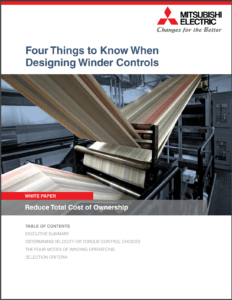
Four Things to Know When Designing Winder Controls – Mitsubishi Electric White Paper – Click to View
Wind/unwind modules operate in one of four different modes. Listed in order of increasing complexity, they are:
- Velocity control with a dancer
- Velocity control with a load cell
- Sensorless torque control
- Torque control with load cell feedback
If you would like to delve deeper into each of these options to discover more detail about the four modes of winder control, please feel free to click on the Mitsubishi Electric white paper cover image opposite.
Manufacturing today is about performance, productivity, and profitability. A properly sized motor paired with an FR-A800 R2R smart inverter operating in the correct mode can deliver solid performance with lower total cost of ownership.
BPX are proud Innovation Partners of Mitsubishi Electric, and since 1989, the largest independent technical distributor of Mitsubishi Electric automation equipment in the UK.
If you would like to discuss inverter winder control with a member of our Application Support Team and Mitsubishi Electric specialist, please don’t hesitate to submit our contact form below, and we’ll be in back in touch at the earliest opportunity to arrange a suitable time and date for us to meet.