

29th April 2025 witnessed the first of three “Future of Automation” events at Oulton Hall, Leeds – launching a series of 60th Anniversary celebrations where BPX suppliers and customers convened to discuss the latest technology and share their project experiences over the years.
It was rewarding to witness the interaction between suppliers and customers that BPX has fostered over six decades since its establishment. Many attendees reminisced about past projects and considered how they might be executed with today’s technology.
Senior Industry Figures Discuss the Future of Automation
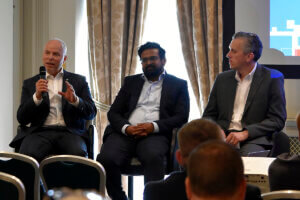
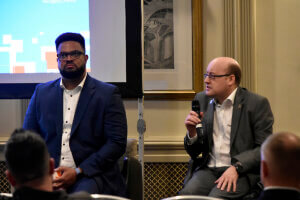
The event featured a presentation and panel discussion that included representatives from major manufacturers such as Mitsubishi Electric, Weidmüller, Schneider Electric, and Phoenix Contact, as well as technology enabler and automation user community UniversalAutomation.Org.
Evolving Challenges and Opportunities for Industry
Topics of discussion were highly relevant, including the future of AI in the automation industry, the growing skills shortage in the industry, digital transformation, challenges for OEMs in today’s business climate, and cybersecurity.
Will decoupling with IEC 61499 work for you?
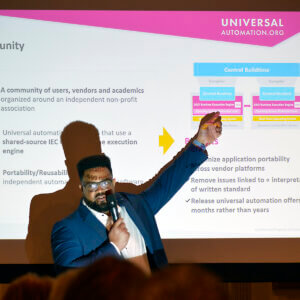
Before the panel discussion, a presentation by UniversalAutomation.Org highlighted its support for the IEC 61499 standard, which advocates for a hardware-agnostic solution, allowing developers to choose the hardware for deploying the final application. This interesting standard offers many advantages, including flexibility, decoupling software and hardware, event-driven function blocks, and application distribution.
The IEC 61499 standard clearly defines the decoupling of hardware and software, providing multiple benefits for automation users (source UniversalAutomation.Org):
- More cost-effectiveness: Develop your application once and reuse it regardless of the hardware vendor.
- Increased reliability and safety due to proven-in-use, reusable software libraries.
- Incremental improvement of automation software applications throughout the lifecycle of machines or processes.
- End-of-life proof automation solutions, enabling the reuse of software applications even when automation hardware becomes obsolete.
- The ability to embed and reuse intellectual property (IP) to protect competitive edge and enhance return on investment in software development.
Following the presentation and panel discussion, customers had the opportunity to pose open questions to the panel, resulting in a lively debate. There was some scepticism regarding the UniversalAutomation.Org solution and whether it could replace conventional control solutions seen today. Nonetheless, there are several successful use cases published on the UAO website that outline compelling benefits.
One prominent argument raised in discussions concerning the adoption of the IEC 61499 standard and methods was the question of economy of scale. For instance, whether its use is feasible for users of compact PLCs (such as the Mitsubishi Electric FX5 range) at the current cost point. Another consideration is whether the cost of suitable hardware serves as a barrier to its implementation. Consequently, this raises the question of whether medium to large-scale systems are the primary target projects for IEC 61499.
Comparisons will inevitably be made with the emergence of the soft PLC in the late 1990’s, the need for a robust hardware platform to deploy the automation project onto often prevents the use of standard PC based offers. Subsequently the traditional hardware vendors have created robust solutions that can run operating systems such as Linux™, or Wind River ™ to host the runtime application.
Piqued your interest? Join the Discussion
Why not come along to the future 60th anniversary events in Loughborough and Swindon, join in the discussion and learn more about the future of automation.